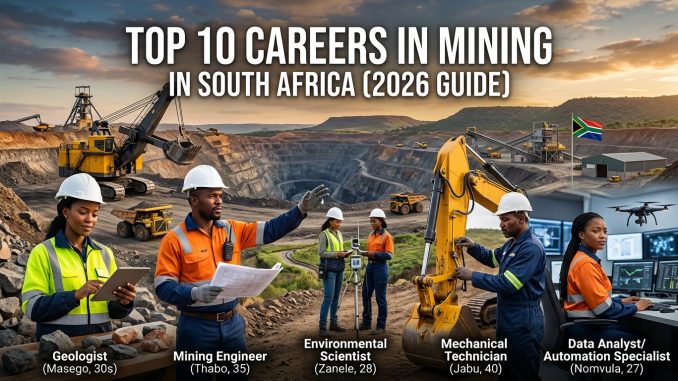
Mining has shaped South Africa’s economy for more than a century. The country is one of the world’s leading producers of platinum group metals, manganese, chrome, gold, coal and iron ore, and the industry still employs hundreds of thousands of people directly and indirectly.
If you are looking for a stable, well-paid and technical career, mining offers many opportunities, and not only underground. Mines need engineers, geologists, metallurgists, electricians, safety specialists and managers to keep operations running safely and profitably.
In this guide, we list the top 10 careers in mining in South Africa, including typical salaries, the qualifications you need and how to get started.
Please note: Salary figures below are indicative annual ranges based on commonly reported market data. Pay varies by company, commodity, mine location, qualifications, shift allowances and overtime. Check current job adverts and salary surveys before making decisions.
Quick Overview: Mining Careers and Salaries in South Africa
| # | Career | Typical Annual Salary (ZAR) | Typical Qualification |
|---|---|---|---|
| 1 | Mine Manager | R1,000,000 – R2,200,000 | BEng/BSc Mining + Mine Manager’s Certificate |
| 2 | Mining Engineer | R600,000 – R1,300,000 | BEng Mining Engineering + ECSA registration |
| 3 | Metallurgist | R500,000 – R1,000,000 | BSc/BEng Metallurgy or Chemical Engineering |
| 4 | Rock Engineer / Geotechnical Engineer | R550,000 – R1,000,000 | BEng/BSc Mining or Geotechnical Engineering |
| 5 | Geologist | R500,000 – R900,000 | BSc Geology + SACNASP registration |
| 6 | Mine Electrical Engineer | R500,000 – R950,000 | BEng Electrical + ECSA registration |
| 7 | Mine Surveyor | R400,000 – R800,000 | Survey qualification + Mine Surveyor’s Certificate |
| 8 | Ventilation and Occupational Hygiene Officer | R400,000 – R800,000 | Diploma/BSc + occupational hygiene training |
| 9 | SHEQ Officer | R350,000 – R750,000 | Diploma/degree in safety, health or environment |
| 10 | Mining Artisan (Electrician, Fitter, Diesel Mechanic, Boilermaker) | R300,000 – R650,000+ | Trade test + N2–N3 or apprenticeship |
1. Mine Manager
The mine manager is legally responsible for the safe and efficient running of a mine. It is one of the highest positions in the industry and requires years of experience.
- Typical salary: R1,000,000 – R2,200,000 per year
- Qualifications: A mining degree or equivalent, plus the Mine Manager’s Certificate of Competency
- Why it pays so well: Total responsibility for production, people and safety
2. Mining Engineer
Mining engineers plan, design and optimise how minerals are extracted, from drilling and blasting to ventilation and production schedules.
- Typical salary: R600,000 – R1,300,000 per year
- Qualifications: BEng in Mining Engineering and registration with the Engineering Council of South Africa (ECSA)
- Why it pays so well: Technical expertise that directly affects safety and profit
3. Metallurgist
Metallurgists work in processing plants where ore is turned into valuable metals. They focus on recovery rates, efficiency and plant performance.
- Typical salary: R500,000 – R1,000,000 per year
- Qualifications: BSc or BEng in Metallurgy, Extractive Metallurgy or Chemical Engineering
- Why it pays so well: Small improvements in recovery can mean millions of rands
4. Rock Engineer / Geotechnical Engineer
Rock engineers assess rock behaviour and design support systems to prevent falls of ground, which remain a major safety risk in underground mining.
- Typical salary: R550,000 – R1,000,000 per year
- Qualifications: BEng or BSc in Mining, Civil or Geotechnical Engineering
- Why it pays so well: Specialised skills with a direct impact on worker safety
5. Geologist
Geologists locate and evaluate mineral deposits, interpret drilling data and help plan where and how to mine.
- Typical salary: R500,000 – R900,000 per year
- Qualifications: BSc Geology (Honours is often preferred) and registration with SACNASP
- Why it pays so well: Their work decides whether a mine is viable
6. Mine Electrical Engineer
Mines depend on large electrical systems for hoisting, ventilation, pumping and processing. Electrical engineers keep these systems safe and reliable.
- Typical salary: R500,000 – R950,000 per year
- Qualifications: BEng Electrical Engineering and ECSA registration
- Why it pays so well: Critical infrastructure and strict safety regulations
7. Mine Surveyor
Mine surveyors measure and map underground and surface workings to make sure mining happens exactly where it is planned and legally allowed.
- Typical salary: R400,000 – R800,000 per year
- Qualifications: A surveying qualification and the Mine Surveyor’s Certificate of Competency
- Why it pays so well: Precision work with legal responsibility
8. Ventilation and Occupational Hygiene Officer
These specialists monitor air quality, dust, noise and heat to protect miners’ health, especially in deep-level mines.
- Typical salary: R400,000 – R800,000 per year
- Qualifications: A diploma or BSc in a related field plus occupational hygiene training
- Why it pays so well: Health regulations are strict, and skilled people are scarce
9. SHEQ Officer (Safety, Health, Environment and Quality)
SHEQ officers ensure the mine complies with the Mine Health and Safety Act, environmental rules and quality standards. They train employees, investigate incidents and manage audits.
- Typical salary: R350,000 – R750,000 per year
- Qualifications: A diploma or degree in safety, health or environmental management
- Why it pays so well: Compliance failures can stop production and cause serious harm
10. Mining Artisan
Artisans, such as electricians, fitters, diesel mechanics and boilermakers, keep mining equipment running. This is one of the best routes into mining for people who prefer practical, hands-on work, and it does not require a university degree.
- Typical salary: R300,000 – R650,000+ per year, with overtime and shift allowances often adding significantly
- Qualifications: N2–N3 or equivalent technical qualification, apprenticeship and a passed trade test
- Why it pays so well: Constant demand and a national artisan shortage
Which Minerals Drive Mining Jobs in South Africa?
The mining jobs available depend on the commodity, and different regions specialise in different minerals:
- Platinum group metals (North West and Limpopo): One of the largest sources of employment
- Coal (Mpumalanga): Supplies power stations and export markets
- Gold (Gauteng, Free State and North West): Includes some of the world’s deepest mines
- Manganese, iron ore and chrome (Northern Cape and Limpopo): Growing export industries
- Diamonds (Northern Cape): Smaller, but still important
How to Start a Career in Mining in South Africa
- Choose the right subjects at school. Mathematics (not Maths Literacy) and Physical Sciences are required for most engineering and science degrees.
- Apply for bursaries early. Many mining companies and industry bodies offer bursaries for mining, geology, metallurgy and engineering students.
- Look at learnerships and apprenticeships. The Mining Qualifications Authority (MQA) supports learnerships and skills programmes, and many mines run their own artisan training.
- Gain practical experience. Vacation work, internships and graduate programmes give you real exposure to mine operations.
- Register with the right professional body. ECSA, SACNASP and other councils improve your credibility and pay.
- Earn your certificates of competency. Roles such as mine manager, surveyor and mine overseer require specific government-recognised certificates.
- Keep improving your skills. Mines increasingly use automation, data analytics and remote operations, so digital skills will set you apart.
The Future of Mining Careers in South Africa
Mining is changing. Companies are investing in automation, renewable energy, data analytics and safer technology. Demand is also growing for minerals used in batteries and clean energy, such as manganese, chrome and platinum group metals.
That means future mining professionals will need both technical knowledge and digital skills. Those who adapt will have excellent long-term opportunities.
Frequently Asked Questions
What is the highest paying job in mining in South Africa?
Mine managers and senior executives usually earn the most, followed by experienced mining engineers, rock engineers and metallurgists.
Can I work in mining without a degree?
Yes. Artisans, operators, drillers, safety officers and supervisors can build good careers through trade tests, diplomas and on-the-job training.
Are mining jobs safe?
Mining remains a high-risk industry, but strict regulations and technology have improved safety significantly over the years. Safety training is compulsory, and employers must follow the Mine Health and Safety Act.
Do women work in mining in South Africa?
Yes. Women now work as engineers, geologists, machine operators, managers and more, and the industry continues to encourage greater participation.
How do I get a mining bursary?
Check the bursary pages of large mining companies and the Mining Qualifications Authority, prepare your academic records early and apply well before the closing dates, which are often in the first half of the year.
Final Thoughts
Mining careers in South Africa offer strong salaries, technical challenges and long-term stability for people with the right skills. Whether you want to become an engineer, geologist or artisan, the first step is to choose your path, apply for bursaries or training and build practical experience.
Looking for your next opportunity? Browse our latest mining job listings and read our related guides below.
Related reading:
- Highest Paying Jobs in South Africa in 2026
- How to Become a Petroleum Engineer in South Africa
- Bursaries and Scholarships for High-Income Careers
- Highest Paying Jobs Without a Degree in SA
Leave a Reply