Last updated: 24 November 2026
Dates change every year. The dates below were checked in November 2026. Confirm all dates and requirements on the official NSFAS website (nsfas.org.za) and the funder’s own website before you apply.
For many South African families, university or college only becomes possible with financial help. The National Student Financial Aid Scheme (NSFAS) funds students at public universities and TVET colleges, and hundreds of bursaries from government, companies and foundations fund students in specific fields. The problem is that deadlines are strict and small mistakes can cost you a year.
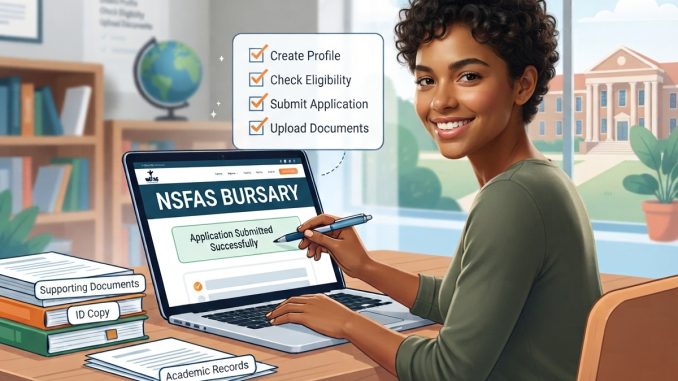
This guide explains who qualifies for NSFAS, how to apply step by step, what to do if you are rejected, and how to find other bursaries.
Key Dates for the 2027 Academic Year
| Item | Date |
|---|---|
| NSFAS 2027 applications opened | 18 September 2026 |
| NSFAS 2027 applications closed | 31 October 2026 (NSFAS said there would be no extensions) |
| NSFAS appeal window (for declined applicants) | 10 to 24 December 2026, with outcomes expected by 9 January 2027 |
| Funza Lushaka (teaching bursary), new applicants | Closes 31 January 2027 |
Some websites listed 18 November 2026 as the NSFAS closing date. Official NSFAS and government communication confirmed 31 October 2026, so always check nsfas.org.za and the government’s news site rather than third-party blogs.
If you missed the NSFAS deadline, see the section “What to Do If You Missed the Deadline” below.
What Is NSFAS?
NSFAS is a government scheme that provides funding to qualifying students at public universities and TVET colleges. Depending on your household income and the qualification, funding can come as a bursary (which does not have to be repaid if you meet the conditions) or a loan. NSFAS can cover tuition and may also include allowances for items such as accommodation, learning materials, living and transport, depending on your circumstances and the rules for that year.
NSFAS does not fund private institutions, and it funds you only after you are accepted at a public institution.
Who Qualifies for NSFAS?
The 2027 NSFAS guidance sets out the following financial and general requirements. Meeting them does not guarantee funding, because your application must also pass verification.
- South African citizen (or another category NSFAS specifically allows, such as some permanent residents)
- Household income: a combined gross household income of R350,000 or less per year for a bursary
- SASSA grant recipients: verified SASSA grant recipients automatically meet the financial requirement
- Persons with disabilities: a combined gross household income of R600,000 or less per year
- Loans: undergraduate students with a household income between R350,000 and R600,000 may be considered for a loan
- Admission: you must be admitted, or planning to be admitted, to a public university or TVET college for a qualifying programme
Whose income counts depends on your situation. For an unmarried applicant, your income and that of your parent or parents is generally counted. NSFAS explains the details in its official FAQ.
Documents You Need
Your document list in the myNSFAS portal is personalised, so follow what it shows. In general, the 2027 guidance says:
- A signed NSFAS consent form is required for all applicants. Without a completed, accurate and signed consent form, your application can be closed and rejected.
- Your personal and household details are completed on the online form.
- Identity documents may be requested, as the portal indicates.
- Other documents if they apply to you, such as a death certificate, divorce decree, marriage certificate, retrenchment letter, proof of guardianship or a disability form signed by a medical practitioner.
- Proof of income is not usually uploaded at application, because NSFAS verifies household income through its own checks. If you appeal a financial eligibility decision, the SARS ITA34 is the accepted proof of income.
- NSFAS guidance also says payslips, IRP5 forms, SASSA letters and affidavits are not required at application, and that a driver’s licence is not accepted as proof of ID.
Because requirements can change and different sources say different things, rely on the official myNSFAS portal and NSFAS guides instead of social media posts.
Make sure all scans are clear, complete and in the format requested. Blurry or incomplete documents are one of the most common reasons for delays.
Step-by-Step: How to Apply for NSFAS
Step 1: Apply to your institution
NSFAS funds you only if you are admitted to a public university or TVET college. Apply for admission directly to the institution and meet its closing dates. A NSFAS application does not replace an application for admission. TVET colleges ran their own admission application windows, which for 2027 closed at the end of September 2026.
Step 2: Create your myNSFAS profile
Go to the official NSFAS website and create a myNSFAS account. You will need:
- Your name and surname exactly as they appear on your ID
- A valid South African ID number
- Your own email address and cell phone number. Do not use someone else’s, because all notifications are sent there.
- The one-time PIN (OTP) sent to activate your profile
Step 3: Log in and click Apply
Complete every part of the online application: personal details, household details, institution details and consent. The portal may not let you save and finish later in all cases, so have your information ready.
Step 4: Complete and upload the consent form
Download the consent form, make sure every person whose income must be assessed signs it, and upload a clear copy. This allows NSFAS to verify household income with third-party sources.
Step 5: Submit and keep proof
Submit your application before the deadline, not on the last day. Take screenshots or save the confirmation.
Step 6: Track your application
Log in to myNSFAS regularly. If NSFAS requests missing information or documents, you are normally given a set number of working days to respond (for 2027, NSFAS said 30 working days). Respond quickly.
Step 7: Check your outcome
NSFAS will tell you whether your application was successful through your myNSFAS profile and the cell phone number and email address you supplied. If you are funded, you may need to accept the funding agreement before allowances and payments can be processed.
What to Do If Your NSFAS Application Is Rejected
A rejection is not always final. Common reasons include missing or unsigned consent forms, mismatched details with the Department of Home Affairs, income above the threshold, or missing documents.
- Read the reason in your myNSFAS profile.
- Appeal through myNSFAS. There is no separate appeal portal. For the 2027 cycle, the appeal window was announced as 10 to 24 December 2026, with outcomes expected by 9 January 2027.
- Attach documents that address the reason for rejection. For a financial eligibility appeal, this includes the SARS ITA34, and where your circumstances changed, documents such as a retrenchment letter or death certificate.
- Submit on time. Late appeals may not be considered.
- Speak to your institution’s financial aid office about other options while the appeal is processed.
What to Do If You Missed the Deadline
If you did not apply for NSFAS for 2027, do not give up on studying:
- Contact the financial aid office at your institution and ask about late funding, institutional bursaries, payment plans and registration options. Do this quickly, because policies differ.
- Apply for other bursaries that are still open (see below).
- Check for TVET or university late intakes where applicable. Some institutions have later dates for some programmes.
- Consider working for a year while you save, build your CV and apply early for the next cycle. Our guides on writing a CV and free tools to learn digital skills can help.
- Prepare early for the next cycle. NSFAS applications typically open around September of the year before you study. Save your documents and set a calendar reminder.
Other Bursaries and Funding Options
NSFAS is not the only option. Bursaries come from government departments, companies, foundations, universities and municipalities. Closing dates range from the middle of the year before you study to early in the study year, so check each funder’s website.
Funza Lushaka (teaching)
This government bursary funds students who study to become teachers at public universities. For 2027, new applicants must apply by 31 January 2027, and returning bursars had to re-apply by 30 November 2026. Recipients are expected to teach in a public school after qualifying, under the bursary conditions. Read more in our guide to police, nursing, teaching and army intake.
Corporate bursaries
Many large companies in mining, energy, banking, telecoms and engineering offer bursaries in scarce fields such as engineering, IT, accounting, science and actuarial work. They often open early in the year for the following year, so check each company’s careers or bursary page. For example, one large energy and chemicals company ran its 2027 bursary window from 1 April to 17 May 2026.
Foundations and trusts
Some foundations fund high-achieving students with financial need, or fund postgraduate study. Examples that listed 2027 funding included programmes in commerce, engineering and science. Always read the eligibility rules and closing dates on the official funder page, because many listings online are outdated.
University bursaries and merit awards
Most universities offer their own bursaries, merit awards and emergency funds. Ask the financial aid office what is available and what the deadlines are.
Provincial and municipal bursaries
Some provincial departments and municipalities offer bursaries for local residents, often in fields where they have skills shortages, such as health, engineering and agriculture.
SETA and industry funding
Sector education and training authorities support learnerships, skills programmes and sometimes bursaries in their sectors. Check which SETA covers your field of interest.
How to Write a Strong Bursary Application
- Check eligibility first. Do not apply if you do not meet the basic requirements, such as field of study, marks, citizenship or household income.
- Gather documents early. Typical bursary documents include a certified ID copy, latest school or university results, proof of acceptance or registration, proof of household income, a CV and a motivation letter.
- Write a personal motivation. Explain who you are, what you want to study, why, and how the bursary will help you contribute to your community or the industry. Be honest, specific and clear. Our guide on how to write a cover letter with no experience shows a simple structure that also works for motivation letters.
- Mention your achievements. Include academic results, leadership roles, volunteering, sports, cultural activities and any projects.
- Get strong referees. Ask a teacher, principal, lecturer or community leader who knows you well, and give them time.
- Proofread everything. Ask someone else to read it.
- Apply to several bursaries, but tailor each application.
- Submit early, and keep proof of submission.
- Prepare for interviews. Some bursaries shortlist candidates for interviews. Our 15 interview questions and answers can help you practise.
- Understand work-back conditions. Many bursaries require you to work for the funder for a period after you qualify. Read the contract before you sign.
Bursary and NSFAS Scams
Students and parents are targeted every year. Protect yourself:
- NSFAS applications are free. Never pay anyone to apply, “unlock” funding or speed up a result.
- Never share your myNSFAS login details, password or OTP with anyone. NSFAS has warned that it will never ask for your password.
- Use official channels only. Go to nsfas.org.za yourself and do not click links in unexpected SMS messages, WhatsApp messages or social media posts.
- Beware of fake bursary adverts that ask for an upfront fee, “registration” or “processing” payment.
- Do not give your ID or banking details to unknown agents.
- Verify the funder. Check that the company or foundation exists and that the bursary is listed on its official website.
Read our guide on how to spot job scams in South Africa, because many of the same warning signs apply to fake bursaries.
Frequently Asked Questions
Is NSFAS a bursary or a loan?
It can be either. Students from households that meet the bursary income limit may receive a bursary, and eligible students above that limit, up to the loan limit, may receive a loan. The rules and conditions are set out in the NSFAS guidelines each year.
Does NSFAS cover private colleges?
No. NSFAS funds students at public universities and TVET colleges.
Can I apply for NSFAS before I have a place at a university or college?
Yes. NSFAS applications and institutional applications are separate, and NSFAS funding is only paid if you are admitted and registered.
Do I need my parents’ documents?
Household income is part of the assessment, and the consent form must be signed by the people whose income is counted. The portal tells you what documents and signatures you need.
What if I receive a SASSA grant?
Verified SASSA grant recipients automatically meet the financial requirement, so income checks are waived. You still need to meet the other requirements and complete the application.
How long does NSFAS take to respond?
The time varies depending on verification and how many applications are received. Check your myNSFAS profile regularly and respond quickly to any requests for information.
Can I get NSFAS if I am already studying?
Yes. Continuing students can be funded, subject to NSFAS rules on academic progress and the time you have already used. Check the current rules and appeal conditions.
Does NSFAS fund postgraduate study?
In general NSFAS funds undergraduate qualifications, with loans available for some postgraduate study up to a certain level. Check the current guidelines.
Final Word
Funding is one of the biggest obstacles to higher education in South Africa, but good preparation can change your options. Learn the dates, gather your documents early, apply as soon as applications open, appeal if you are rejected and never pay for something that should be free.
Once you qualify, your next step is employment. Browse the latest learnerships, internships and graduate vacancies on JobsSpace.co.za.
Related reading:
- Police, Nursing, Teaching and Army Intake: Requirements and Dates
- Beginner IT Careers in South Africa and the Qualifications You Need
- Free Tools to Learn Digital Skills (Excel, Coding, AI)
- How to Spot Job Scams in South Africa
Leave a Reply